
Narrelle M Harris spoke to Jo Dixon, the Tasmanian author of three crime books, for this month’s Author Spotlight.
A Disappearing Act is a cracking good read, with some great reveals along the way. How long have you had the idea for this story? Has it changed much since the idea first came to you?
The first, rather vague idea for this story came to me on my 50th birthday a few years ago. Three of my oldest friends came down to Tassie to celebrate, and we hired an island for a bit of a getaway (just a tiny island, completely off-grid and covered with penguins). As we clambered up onto the jetty, I thought, four of us arrived, what if only three left. (Spoiler: We all left the island intact!) When I finally began writing the book, it did evolve considerably, but the idea that you don’t always know your friends as well as you think – even your oldest and dearest – remained at the heart of the book.
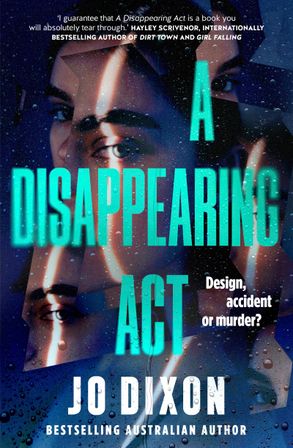
The plot is ignited by questions of whether the character of author Marnie Elliott wrote her own books. Although her background is very different to current anxiety about the role of AI in writing, the two concerns feel related. Did AI concerns feed into your story in any way?
Not AI specifically, but I am fascinated by some of the true stories of authors behaving badly – and also the lengths people might go to, to either belong to a group or to achieve their dreams. Of course, with AI now upon us, I can imagine a writer using it as a tool to create stories and books that they haven’t written.
The action switches back and forth between 1999 and 2024. How difficult was it to work out how much to balance the reveals in each setting? (Did you need a whiteboard or one of those crime boards covered in red string?)
Post-it notes, Scrivener, and, yes, a crime board! I really enjoy writing – and reading – dual timelines, and it can be tricky to keep both timelines interesting, and to balance what the characters and the readers ‘know’ at any point. I feel this is a good example of how reading widely within the style and genre helps a writer. When I write, I get a sense of the flow of the story, when to move between timelines, and when to drop those revelations.
The wildly artistic share house in 1999 Melbourne is vividly Bohemian and a great contrast to the constrained and anxious atmosphere of the holiday house in Tasmania. Did anything in particular inspire that share house?
I lived in Melbourne for a few years in the nineties, sadly not in a warehouse, but I was in my early twenties, and found an amazing group of friends there (yes, those same women who scrambled onto that penguin covered island for my 50th birthday). Walking around Melbourne these days, I am fascinated by the laneways, by the history of these old red-brick buildings, and what they’re doing with them now. I tend to write into my stories, settings, and scenarios that grab my attention (particularly houses and homes); in this case, I loved imagining life in one of those old warehouses.
The four friends at the centre of A Disappearing Act – Marnie, Sarah, Xanthea, and Poppy – have known each other for 25 years, yet in many fundamental ways they don’t know each other very well at all. Does this dynamic reflect anything of your own experiences of long-term friendships?
I had a phrase stuck in my brain as I wrote this book – your oldest and dearest friends know you best and forgive you the most . . . don’t they? I feel there is a different dynamic between those friends who have known you through all your phases (the good, the bad, and the ugly) and those who know you as you are now. With those old friends, you can go long stretches of time without seeing them, then when you get together, it’s like no time has passed. Yet, time has passed, and no amount of recounting ‘what’s happened’ in those weeks or months will really fill in all the blanks. We compress our stories, gloss over the emotions that might have been more extreme in those moments. Yet … those old friends know you in a way that no one else ever will. They hold your secrets and, in my experience, judge you less and celebrate you more.
Your three books to date explore women who are fleeing from harsh scrutiny, questions of trust, and the way old secrets have of coming inconveniently to light – a perfect triumvirate for crime fiction! What draws you to these themes?
Doesn’t everyone dream of running away, of disappearing for a time, of starting again? No? Okay, maybe it’s only me! But yes, I love to live through my characters. I give them a reason to want to run and hide, then throw in some questionable sorts and reasons not to trust them. As for secrets . . I’m fascinated by what people keep hidden, from themselves and from others.
A Disappearing Act is your third book to be largely set in Tasmania. What is it you find about Tassie that makes it a particularly suitable setting for your stories?
I like to write settings that feel real to the reader, and with Tasmania as my home, it feels appropriate to put this beautiful place front and centre. At the same time, Tassie has some real advantages as a setting – it’s not huge, but there are so many corners to explore, plus, to many mainlanders, Tassie can seem very ‘other’. It is also a great place to run away to and to get lost in. The wilderness here is breathtaking but also intimidating, which only adds to the atmosphere.
The reward, of course, for writing a terrific book is that readers want another one, ASAP please. Are you working on something new? If so, is it inspired by similar themes?
I’m glued to my laptop, working on the next book, hoping to have it off to my publisher before the end of February. It is set in Tassie again (no surprise), this time on a fictional island off the north coast. This one will be a single timeline with multiple POV (at this stage!), and features a group of corporate executives of varying ages, whose ‘resilience retreat’ takes a rather nasty turn. Stay tuned!
More info here.