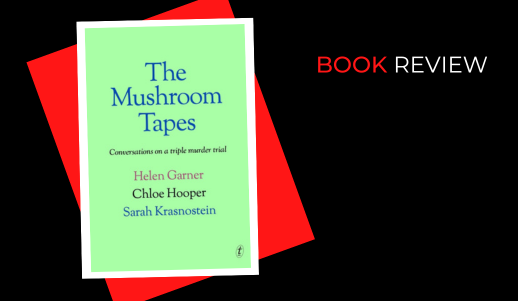
Authors: Helen Garner, Chloe Hooper and Sarah Krasnostein
Publisher: Text Publishing
Reviewer: Rachel Spencer
There would not be many readers in Australia who were unaware of ‘the mushroom case’ in 2025 which culminated in a jury deciding beyond reasonable doubt that Erin Patterson murdered three people (her father-in-law, mother-in-law and her mother-in-law’s sister) by feeding them death cap mushrooms which she dehydrated and concealed inside individual serves of beef Wellington at a family lunch. The hugely publicised and incessantly discussed trial began on 5 May and concluded on 8 September 2025 with Patterson sentenced to life imprisonment.
Imagine what it would be like to be in a car listening to three of Australia’s most celebrated writers discussing Australia’s most talked about murder trial in recent history , as they drive almost two hours each way from Melbourne to the court in Morwell on each day of the hearing. What would it be like to get inside the thought processes of literary luminaries Helen Garner, Chloe Hooper and Sarah Krasnostein? Wouldn’t it be fascinating to know what they were thinking as they listened to the evidence? To share the literary and intellectual connections that they crafted as they drove between Melbourne and the court in Morwell? The Mushroom Tapes gives us this opportunity.
This true crime book appears at first glance to be a cursory telling of a story that none of the authors were originally going to go near. An unedited transcript of a bunch of conversations in the car. Simple. No fuss. Not much effort.
‘None of us wants to write about this. And none of us wants not to write about it.’
Don’t be fooled! Beneath the chatty banter of three women who have ‘never travelled anywhere together before’ lies the enviable collective skill of three fine writers whose shared talent is to make story-telling look easy. Hooper enters the project hoping that they ‘can make something more than the sum our parts.’ The plan works.
Motivated by a desire to resist writing a voyeuristic, exploitative account, Garner explains: ‘We’re bearing witness to a rent in the social fabric and how the law is going to deal with it … but I would hate to think I was just perving’. Hooper is wary: ‘I guess the Daily Mail and the Herald Sun and a flotilla of other journos will also be in Morwell bearing witness. Is our bearing witness actually more high-minded or are we dressing up our own motives?’
This is a story of many tangents. Interwoven with the trial of Erin Patterson we eavesdrop on conversations about the slow disintegration of her domestic life, the role of Baptist Christianity in the lives of Erin and her victims, the possible motivations for murder, the concept of Medea in reverse, the camaraderie that develops between people who come to watch the trail, the public fascination with female poisoners, and the female fascination with true crime. And Garner’s particular interest:
‘What’s fascinating about crime is that there’s a sort of membrane that separates people like us, ordinary people who don’t murder, from someone who does. And I always want to look at the person whose foot has gone through that membrane, who has wrecked their own life by ending someone else’s … ‘Who hasn’t thought, Oh, God, I’ll kill that bastard? So I always have a weird kind of empathy for the person in the dock, and it comes and goes as the trial proceeds; it’s not that I’m big-hearted or anything, it’s just that I have this awful feeling – that could be me.’
Unlike many true crime books that gloss over the legal details, Sarah Krasnostein (a lawyer) filters her experience through a useful legal lens that shapeshifts the complexities of criminal procedure into useful but accessible snippets of background context, so the reader is not overwhelmed with complex legal theory but can see how (and often importantly why) the legal system deals with certain aspects of the case in a particular way. For example:
‘People are forced by the rules of Evidence to disclose things in public that they would probably not even admit to themselves. And you can do two things with that. You can digest it into content that people come to ogle out of schadenfreude, or you can say, ‘Oh, God, I know that feeling. I haven’t had that exact experience, but I know what shame is, and I know what rage is, and I know what it is to be isolated and desperate.’
And:
‘In a courtroom, you’re watching an artifice at the best of times. The legal story is always haunted by a whole chunk of reality that’s excluded from the room by the rules of evidence.’
Erin Patterson was wealthy, intelligent, professionally successful, and a mother of three children. The three authors endeavour to understand her complex character through watching her in court and listening to the evidence of witnesses. Her mother, a feminist atheist, was a very driven and hardworking academic but Erin called her ‘a cold robot’; her Jewish father was a company director. Much of Erin’s social life was online – she was a member of several online Facebook groups with an interest in True Crime. Now she is the subject of her very own true crime story.
‘She sits in the dock at the back of the courtroom, flanked by two custody officers. She wears a taupe-coloured top. Her long hair is long, dark and straight … The woman who appeared on national news bulletins weeping flamboyantly for her dead relatives has disappeared. The gravity of the room has stripped away any layer of the ridiculous.’
There are moments in the text which are masterclasses of ‘show don’t tell’ crime writing. This is my favourite:
‘There’s the hum of the split-system heater. The susurrus of lawyers and journalists typing out his words.’
And of course there is the whole topic of female poisoners, a subject Garner describes as ‘the flip side of mothering’ … ‘It’s the most appalling betrayal of what women are supposed to be like. We’re supposed to nourish and put in front of people food that brings life to them. This story is an inversion.’
What makes this book a page-turner is the continual sprinkling of ideas that evaporate after a few paragraphs. Chloe muses on Erin’s mother being an expert in children’s literature and the fact that:
‘mushrooms often appear in children’s literature – this has elements of a fairy story her mother might have read to her, with a forest and witchiness and food changing in front of the guests in a deadly way’.
Sarah ‘keep[s] thinking about psychological poison – the way the emotions that drive murder grow in darkness. Like mushrooms.’
Garner is forthright about female violence:
‘In order to live a life, women have to throttle back in themselves huge amounts of aggression. So I’m never surprised when I hear about a woman killing someone.’
Writing true crime is fraught with ethical complexities of which Hooper is uncomfortably aware: ‘This trial is being used for public entertainment. I feel squeamish about joining the pile-on.’ In Krasnostein’s words, ‘[i]t’s how you go about it – not just what you look at but how you look at it.’
This is a sensitive, compelling and elegantly written narrative, ‘looked at’ in a way that is simultaneously familiar and ground-breaking. This is ‘bearing witness’ that is indeed more than ‘just perving’.
Publishers blurb:
In July 2023, in the quiet Gippsland town of Leongatha, Erin Patterson—stay-at-home mother and true-crime devotee—invited her husband’s devoutly Christian family to lunch. Within days, three of her guests were dead and the fourth was in a coma. They had all been poisoned by death cap mushrooms.
Two years later, Patterson stood trial, accused of three counts of murder and one count of attempted murder. The court case gripped the nation and fascinated people all over the world.
Among those drawn into the drama were three renowned writers: Helen Garner, Chloe Hooper and Sarah Krasnostein.
Together, they joined the daily media scrum at the Latrobe Valley Law Courts and spent long days immersed in the case’s sinister and complex themes: love, hate, jealousy, revenge, marriage, money, mycology and murder.
The Mushroom Tapes is a true-crime book like no other—a unique study of Erin Patterson and our collective obsession with her strange and terrible crime