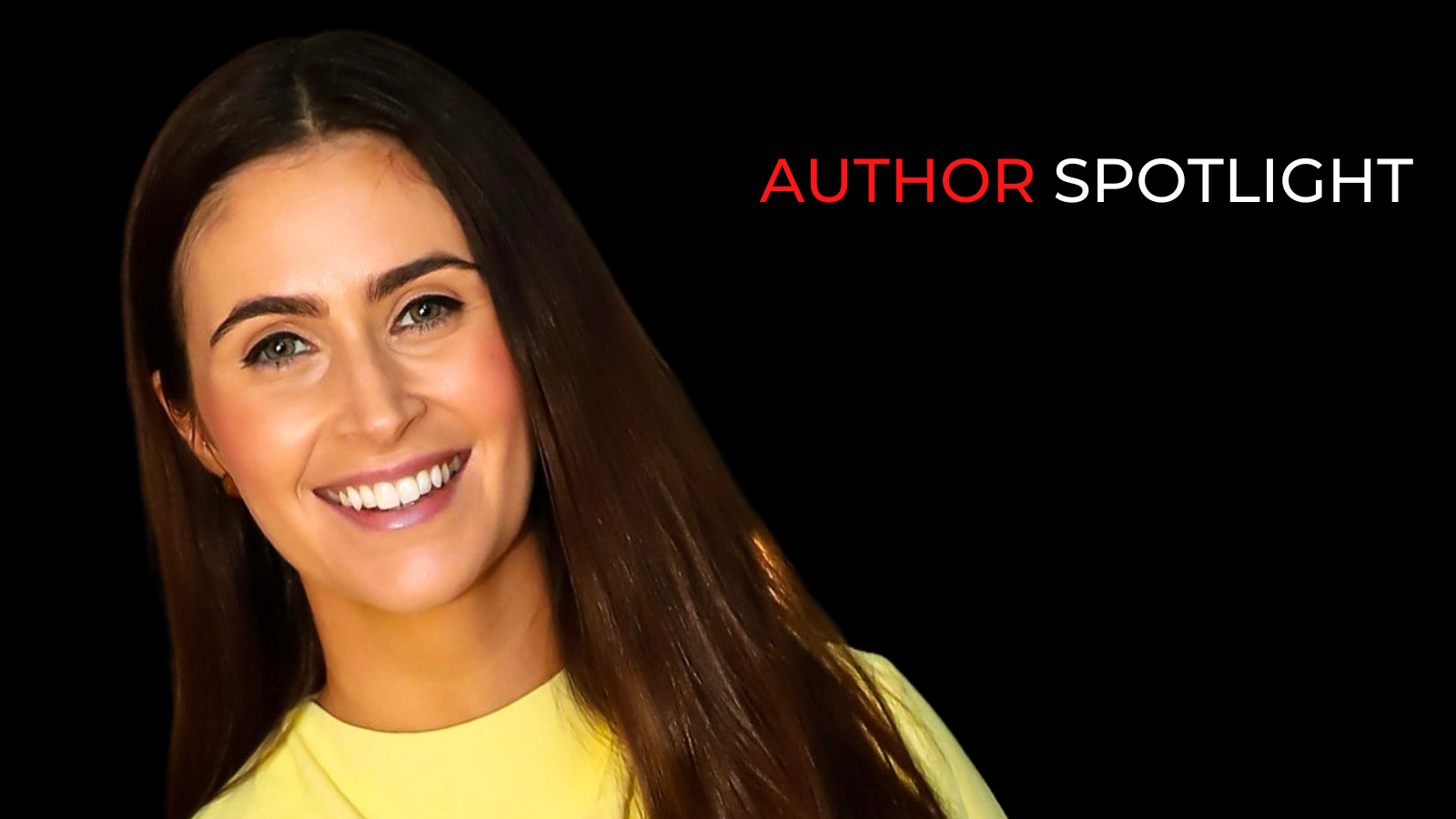
Melbourne author Abby Corson spoke to Georgie Baron-Ross for this month’s Author Spotlight about her latest novel, Happy Woman.
Hello Abby. Firstly, congratulations on the release of Happy Woman, a sharply unsettling novel that peels back the veneer of domestic contentment amongst the Hogg family.
At its centre is Gwynne Hogg — a ‘normal’ woman whose life unravels when she discovers her beloved father is a serial killer. As his decades-old secrets surface and the media closes in, Gwynne is forced to reconcile the man she trusted most with the crimes he’s accused of, all while holding together a crumbling family, a demanding career, and her own increasingly dark thoughts. Happy Woman is a gripping exploration of inherited fear, moral unease, and the fragile stories we tell ourselves about happiness.
The title Happy Woman feels deliberately loaded. What does ‘happiness’ mean to you in the context of this story?
It’s so loaded, isn’t it? A common response I’ve had from people to the title is, “but, what is one?” Others have said that one simply doesn’t exist. Some may be able to identify the root of their happiness quite easily, for others it may be more complicated. But for this book, I channelled the thing that I truly believe my own happiness hinges on – my family. If my family is good, I’m good. If something is unsettled within my family, the other things that would usually bring me joy probably aren’t going to in the same way. You’ll see within this story that the more Gwynne’s family falls apart, the more her mental health declines, and those things she probably thought made her ‘happy’ flashy things, career, financial freedom – cease to matter. Ultimately, happiness might not even feel like happiness at all, it might just be a feeling of contentment that you only recognise as happiness once it’s taken from you.
Family dynamics sit at the heart of the novel. Were you more interested in what families reveal about us, or what they conceal?
This book is deeply self-reflective to the point of unease for the reader. It’s all about questioning why we are the way that we are, and when that sort of reflection takes place within a moment of human fragility it can really take you on a journey. It can often be uncomfortable, especially when it is forced upon us because of some sort of event that has taken place. And the answer to the question of ‘why am I like this?’ can often be traced back to family and upbringing – whether we like it or not.
For context, my own father is a psychologist. From a young age, he would take me to our local pub on Sunday evenings, and we would talk about life, about people, and, more importantly, why we, and why other people are the way that that they are. He’d help me understand myself and the people around me. These weren’t always easy conversations, as it’s not always overly comfortable admitting that you are flawed or perhaps even more so, that the people you love are. I think ageing brings with it more opportunities for this sort of deep self-reflection as we’re faced with more challenges and must own our reactions. So many of these challenges are to do with family; new babies, a sick parent, divorce. What sort of role within your family did you play during these times? And what does that say about you? And, more strikingly, why did you act like that?
Your characters resist simple moral categories — they’re neither wholly ‘good’ nor ‘bad’. Was that complexity intentional from the outset? And how did you work to build tension through relationships rather than relying on plot alone?
Absolutely! I love that grey zone when it comes to characters because it forces the reader to think about how they would feel about them if that person were part of their life. So often the people in our lives – particularly family – come with good and bad qualities, and we have to decide how we want that relationship to look based on what we know about them. Being family complicates relationships so much more than just being friends. We tolerate more because there’s a familiar bond. We bend the rules because of love or history. In the book, Gwynne experiences this tug of war on a daily basis, and we can see the impact that it has on her. By making the characters morally grey, I think it helps the reader connect to the emotional torment that Gwynne suffers because yes, her dad is a serial killer, but he’s also so many other things to her that the reader can hopefully understand how her heart is pulled in different directions. Relationships with family are not black and white.
For me, the relationships were always more important than the plot. When I started thinking about what sort of story I wanted to tell, I began with the idea of this complex family dynamic and all the unique individuals within it. While in times of peace, everyone operates in harmony, but when that unit is thrown into chaos, they are not only trying to hold themselves together but also trying to process how each other is coping in unfamiliar territory. Ultimately, the plotline became the backdrop in which this could happen in an amplified, dramatic way that would make for an engaging story. The plot is the cocktail shaker that this family bangs and clatters around in, not knowing how they will emerge from it. But ultimately, it’s not the shaker we’re paying attention to; it’s what’s happening inside!
There’s a persistent sense of unease running through the novel. How did you think about pacing that tension without leaning on major twists? How did you decide what to reveal to the reader — and what to hold back?
The reader’s unease was designed to mirror Gwynne Hogg’s unease. The pacing had to allow for a discomfort to build and to give the reader an opportunity to process those morally grey characters at the same pace as Gwynne. To go back and forth on what they would do enough times that they empathise with how unsettled Gwynne would be. I don’t think I held back a whole lot. The emotions and reactions are so raw that if you really look at it, Gwynne’s ‘why?’ is right there in front of you.
The idea of a ‘happy woman’ often feels socially constructed. Were you consciously interrogating expectations placed on women? Do you see happiness as something your protagonist defines for herself, or something imposed from the outside?
Absolutely. What on earth is a ‘happy woman’? It’s a narrative that the outside thrusts upon someone because of a perceived image. People saying, ‘Oh, well she has this and that and this . . . so she must be happy.’ And if a woman is seen to not be happy with all those things she has, she must be ungrateful. But in modern times, being a woman is such a juggle, and the pressure to seem like you’re handling everything just fine with a smile on your face can be exhausting. I think the reader would identify this exhaustion in Gwynne and then ultimately see how she can’t keep up the façade. It was really important to me not to follow the common narrative of a woman going through turmoil and overnight turning into a psychopath. This is a slow, realistic mental health decline that isn’t linear. One day she’s struggling to get out of bed, the next she has to show up for her family. That’s what life is like for a mother and wife.
As I said earlier, I believe happiness is so fleeting that we shouldn’t generally thrust the word upon a person as it’s truly impossible to live up to that image. At the end of the novel Gwynne reaches a place of contentment and I believe that is where happiness is found.
What was the starting point for the novel — a character, a situation, or a question?
And did the story change in any significant ways as you wrote it?
It honestly started with a conversation with my husband about how would you feel if one of the most important people in your life let you down in a way that completely changed how you viewed them? This was in relation to family and forced me to reflect upon my relationship with my own dad. Gwynne’s relationship with her father is very much reflective of my own (minus the serial killer part). This allowed me to connect deeply with what she was going through as I slipped easily into her shoes. Once I realised the power of this connection, I introduced Gwynne’s daughter as a way to further connect with her, as that allowed me to dig deeper into Gwynne’s emotions and how her mental health battle would unfold. The story, while not true to my own life, is very raw for me and at times was very emotional to write.
If readers finish the book questioning something about their own relationships,
what would you most like that question to be?
How would I react if this person I loved and trusted the most in the world wasn’t actually who I thought they were? And what role do I play within my family or relationships? Can I identify any of my own flaws that I might have inherited from my parents?
Finally, for writers working toward a debut: what’s one piece of advice you’d offer to those trying to finish their first book and find a path to publication?
Do it because you enjoy it and not because you think you’ll enjoy how it feels when you are eventually published. Enjoyment from the journey should come before enjoying the outcome because the road towards publication can be long and, at times, disheartening. Sink into those late-night rewrites and messy drafts because you’re doing it, you’re being a writer! And isn’t that cool? If you love the journey, you won’t quit before reaching your goal.
More info here.