
Narrelle M. Harris spoke to Tanya Scott about her debut novel, Stillwater (Allen & Unwin). Tanya is a medical doctor living on Victoria’s Surf Coast.
Stillwater applies equally to your lead character, Luke Harris, whose still waters run very deep indeed, as to the bush block location of key events. Was it always your preferred title?
I played with about ten different titles, most of which were bland and uninspiring. The first working title was Adventure, which was a simple description of Luke’s life. I think titles are incredibly important; they set a tone for the book, and also give readers a smug ‘A-ha!’ moment when the reference clicks into focus.
The title Stillwater came to me when driving to work early one morning. I crossed the new bridge over the Moorabool River on the outskirts of Geelong, and as I did, I looked upriver to the old bridge, a crumbling stone structure from the nineteenth century. The water was perfectly still, reflecting the trees and sky like a silver mirror. The peace and beauty of the moment made me pull over; the image encompassed everything I was trying to express. But although I appreciated the flash of inspiration, it made me late for work!
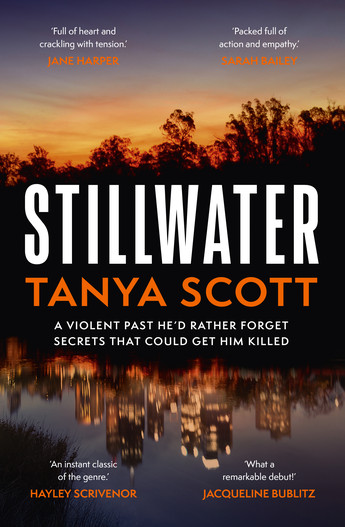
Your descriptions of the property at Stillwater are very vivid. Are they based on a particular place?
Stillwater is a fictional setting, but it’s inspired by the incredible Box Ironbark forests of Central Victoria. I’ve stayed in Castlemaine and surrounds many times, and I love the spookiness of the forest on foggy mornings. I made a pilgrimage to research the area, particularly looking at the ruins of gold-mining sites, but most of the photos I took were of wildflowers – tiny jewels of colour among the grey-green and earth. It’s an amazingly beautiful landscape.
The image of the still water of the dam comes from growing up in country Victoria, where I spent many weekends on friends’ farms or out in the bush. For me, dams always evoke a sense of peace and isolation – although I never liked swimming in them, because I was worried I’d step on something unsavoury!
We meet Luke as an empathetic disability support worker, who approaches life with astonishing compassion and level-headedness, considering his past – but he can also be, we learn, a classic action antihero – taciturn, troubled, an adept liar when necessary and, when forced to it, an efficient criminal enforcer. Despite this darkness, he remains sympathetic. How hard was it to find the balance between these sides of his character?
Stillwater started with Luke’s character. I was studying a writing course during the pandemic, and one of the assessment tasks was a character study. It was a great exercise – developing a character that is fully rounded, not just a physical presence but with hopes, dreams, flaws, likes, dislikes, and a whole backstory of experiences. Given his early life, he was always going to be morally ambiguous, but with his own compass for right and wrong.
Characters evolve with the story they’re placed within (just as real people do!), and I found that as I wrote Stillwater, I learned more about Luke from how he reacted to certain situations and when interacting with other characters. While I wanted to explore the effects of intergenerational poverty, childhood adversity, and exposure to the criminal world – without glossing over the seriousness of these – I also wanted Stillwater to retain some light and humour. Luke’s story is essentially one of hope – that recovery and progress after a rough childhood are possible.
I’d like to claim that finding the balance in his character was intentional, but I’m not much of a planner. I write in a ‘discovery’ style where I figure things out as I go, which is a messy and long-winded approach, which I do not recommend – I’d love to be good at plotting! I think most people are a series of contradictions and flaws, and Luke is no different (although he does have a useful set of skills).
What of your own experiences/philosophies as a mental health practitioner did you draw on to develop Luke’s relationship with the very different male authority figures in his early life (Quin, Kevin, Gus, and Dr Bowman), and how Luke deals with the traumas of his childhood?
Over a few decades working as a GP and in mental health, I’ve met many patients who have struggled against the kind of societal disadvantages that Luke faced. Some people are dealt shitty cards at birth. No one chooses to be born into poverty, or to have parents who die, use drugs, or go to jail. I’ve always found it fascinating that some can find a path through it, while others are stuck with the same problems. There is a wealth of research about the effects of childhood adversity on physical and mental health, and there is parallel research about the factors that protect and compensate for these experiences. When talking to patients who’ve come through the other side, it’s often the simple things – one trusted teacher who believed in them and kept them coming to school, a grandparent who slipped them money for food, or a sports coach or counsellor who taught self-discipline or emotional regulation skills.
Social programs to protect kids at risk, such as school breakfast or lunch programs, parenting support, expanded access to health and psychological services, easy access to drug rehabilitation and diversion from the criminal justice system for minors, are known to be cost-effective and good economics for governments. It saddens me that they are so poorly funded. As a society, we should be judged on how well we treat our most disadvantaged, not on whether we can build spaceships. The evidence is clear that looking after kids keeps them out of jail.
Luke has a variety of male role models, who vary in their competence, maturity, and also in their ethics! He learns different lessons from all of them. It’s important as a writer not to cast any character, even the hero or villain, as purely good or evil; humans are usually more complicated than that. Ultimately, Luke has to learn to make his own choices in order to find the peaceful life he wants.
The character of Dr Bowman was a pleasure to write, because I would love to have his patience and calm. He has a knack for saying the right thing at the right time. In real life, counselling is a much messier process! His advice helps Luke reframe his experiences and move forward, and he encourages Luke to make intentional choices rather than being swept up by his chaotic life. His words might not sink in straight away, but they return in Luke’s mind years later as wise advice – which is what every counsellor hopes for.
Emma Wiley is a bright presence, providing an excellent foil for Luke’s more reticent personality, who is able to draw on her gifts as an actor as her world gets more complex and dangerous. How did you go about developing her character? Did she arrive ‘fully formed’ or did she develop in response to the story?
Emma is a reflection of many young women I met in medical school – smart, educated, privileged, and somewhat sheltered in her view of the world. I had a clear idea of who she was from the beginning, but she also evolved with the story as Luke did. In particular, her relationship with her father became more complex as the story developed. I find the relationships between parents and their adult children fascinating. When kids are young, they view their parents through the lens of their role as mother or father; as they mature, they’re faced with the reality that their parent is an individual with their own life – and, often, quirks and flaws. Similarly, for the older generation, accepting that the child is their own person and not an extension of the parent can be challenging.
There is a clear contrast between the controlling way Emma has been parented and Luke’s experiences of neglect, which demonstrates how either extreme is unhealthy.
I’d love to see more of Luke – do you think we might see him again?
That’s an excellent question!
If not Luke – do you have another book brewing? And can you give us any hints?
I’m working on another novel, which is set in the same world as Stillwater, but with a different protagonist and an entirely new story.
More info here.