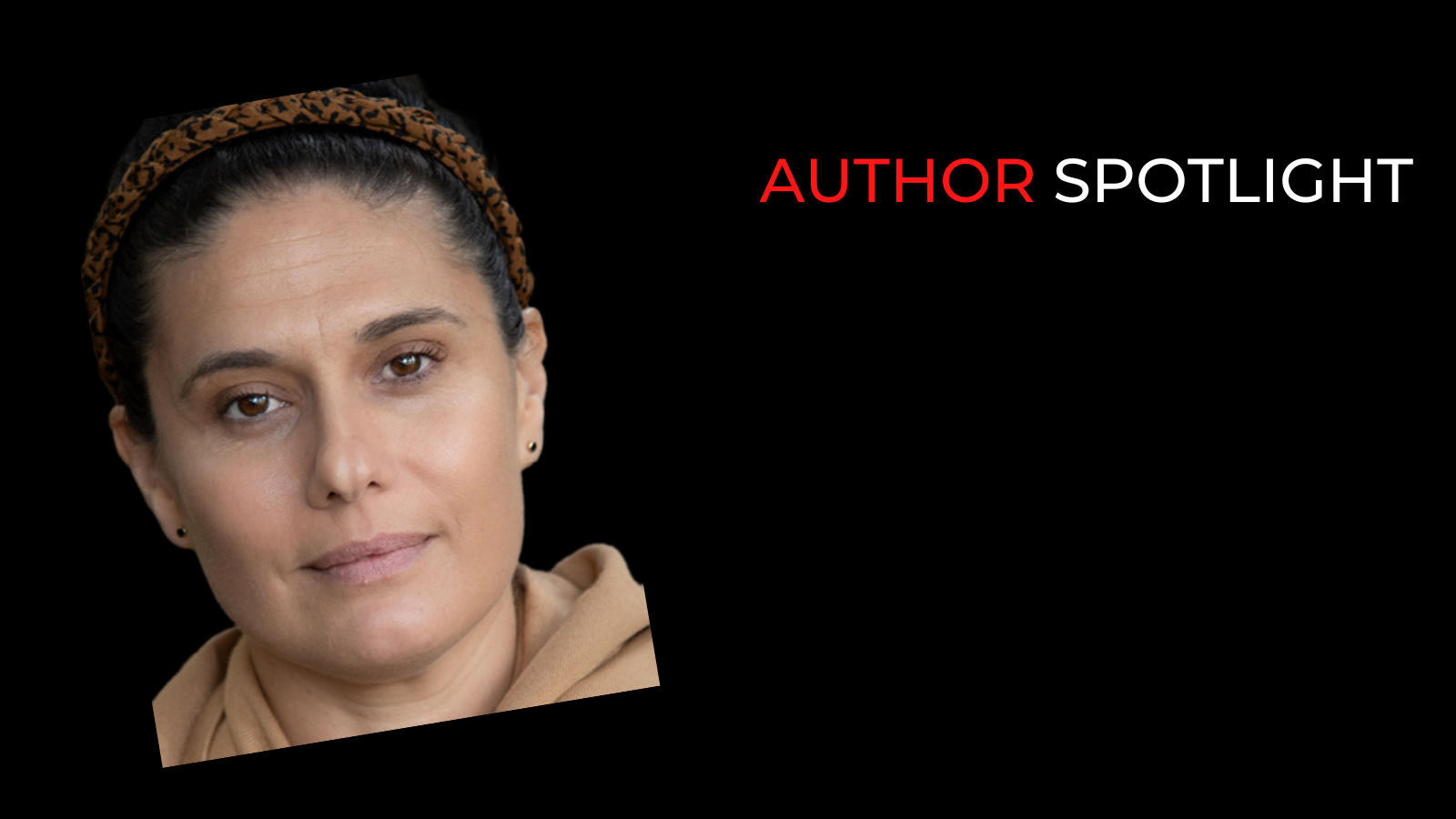
Ruth Wykes, Sisters in Crime’s review editor and awards’ coordinator, spoke to Angie Faye Martin for this month’s Author Spotlight.
Sha says, “When I sat down to read Melaleuca by Angie Faye Martin, I knew nothing except that the author was a First Nations woman. It was such a surprise that within a few pages I was transported back to my own childhood in the bush, and to a yearning for country that has never left me. For the first time in my life, I saw my own experiences of cultural identity, belonging and abandonment reflected in a crime novel.
“Melaleuca is a beautifully written, absorbing crime novel that introduces us to a stunning new voice to Australian women’s crime fiction.
“The author, Angie Faye Martin is an inspiration. Angie is of Kooma, Kamilaroi and European heritage. She holds a Bachelor of Public Health, a Masters of Anthropology and worked for many years in policy roles in state and federal government. I was fascinated to learn more about Angie, and wanted to know how the storyteller in her emerged.”
It’s really rare for a First Nations writer to turn her creative attention to crime. Where did that come from?
You know, I don’t think I set out to write crime to be honest. The story I wanted to tell I just needed a detective because I had a murder and then the character of Renée slowly emerged. I realised I needed someone and I toyed around with the idea of a private investigator or something for a while – or a journalist. But then I was like “no you gotta be a cop” in order to get the backstory and everything to work.
I had a few reservations about it, ‘cause I was like oh my God, my protagonist is a cop and obviously I’m Aboriginal. My dad’s family set up the Aboriginal Legal Service in Toowoomba so I’m very familiar with our people’s issues with the criminal justice system. But then I thought this might be a way to explore it and expose it a bit.
One of the things I really loved was your observations of the small moments with your characters. One that comes to mind was when Renée found her mum naked in the bathroom. The tiny interchange about the underwear was one of many small moments that add depth and nuance to your characters and their relationships.
Yeah, I think that was essential because the book explores such heavy things like sexual violence and coercion, like using drugs, to the treatment of women. That’s really heavy kind of material and I’m drawing from not my own real-life experience, but people I know and love, So it’s difficult to write but then I needed to have those light moments like Val and Renée in the bathroom just for my own peace, as well as the readers.
The depth of character and those small moments made me wonder. Are you a people watcher?
Absolutely, yeah. I can sit and have a coffee in the mall and just watch people. And I pick up things, the little goings on. I really enjoyed writing the scene of the naughty boys down by the creek. It was like my little brother and my little cousins being shits down there and you know, the next generation coming through.
There is a strong theme of identity threaded through Melaleuca, especially through the character of Renée. I thought it was wonderful and I’m curious about how conscious you were in approaching the way you wrote it.
So, I think I drew a lot from my work in the public service to be honest. I don’t know what it’s like working as a cop, that’s completely foreign to me, but I worked in the public service for a long time and I think I really wrestled with it.
You know, am I working for the community or am I working for the government? Am I doing the right thing? When I started writing I was really grappling a lot with these concepts of self-determination and sovereignty, feeling a bit out of place. I didn’t know whether I wanted to work in government or in the community sector. I felt like, when I was in government, I’d go and meet with community people in the community sector – non-Indigenous people – and almost more black than me. It was a real mess with my head.
Like where do I come from? Sometimes I was like have I have gone that far from my roots that you think you can talk to me like that but then yeah so that’s personal but that you know it’s so frustrating that feeling when you’re not seeing the way you want to be seen.
Because you deal with it also a little bit from the other blackfullas and from non-indigenous people. They don’t want to know you because you’re black but then for some Indigenous people you’re not black enough. It’s such a difficult identity in Australia, it’s like what the hell do you want me to be?
I grew up on a farm near a small town of 500 people and your fictional town felt very familiar to me. It led me to think about the setting you created in Melaleuca.
Yeah well, I write a lot of it when I was actually in Covid lockdown down there in Melbourne, when I was in Donvale, and I was really missing home. I would go for walks along the Mullum Mullum track down there and just be really nostalgic because my pop was sick up in Oakey and I desperately wanted to go home and see him and then also my dad and my nan were all up there in Oakey and I wasn’t allowed to leave and so I think Oakey really came alive in my mind because I was missing it so much.
Did any of the characters surprise you? Did they try to take you off in a different direction to where you thought you were taking them?
I want to give you one answer but then you wouldn’t be able to print it because it’s a spoiler.
I’m really curious. You had a big career in public service and you had a Bachelor’s degree, a Masters degree and the writing during your career would’ve been so different. How did you go when you first started becoming a storyteller rather than a formal writer?
That’s such a good question. I think I couldn’t express myself sufficiently in academic and government writing and I got frustrated because I couldn’t express what I wanted to regardless of how strong the essay was, or how convincing the argument was. I just kept coming up against walls, whereas when you write fiction it’s a story and people can’t argue with it. It’s like an invitation to empathise with a character and I just fell in love with writing fiction and it was a natural to be honest.
You just go into the zone. I read a few craft books and taught myself. You know the craft elements of fiction but it was just a beautiful liberating feeling of being able to write a story. Then I’d give it to a few friends and they were like ‘yeah, that’s pretty good. Keep going’.
You’ve written a dual timeline which is interesting and necessary to the story because Caroline and Bessie’s story is so powerful. Why did you choose to set the contemporary timeline in the year 2000?
It took me ten years to write this book. I did it in 2000 so the ages of the characters work because I wanted the dual timeline to be just before the Referendum because that’s when the camps really changed in Queensland.
[At the May 1967 Referendum, 90.77 per cent of Australians voted for Aboriginal and Torres Strait Islanders to be counted as part of the population and the Commonwealth would be able to make laws for ATSI Australians.]
I felt like I knew all your characters and was surprised by their complexity. Was that something you were deliberate about or was it organic to your storytelling?
I like writing the ones like Gappy You know, I wanted Gappy to have a few vulnerabilities ‘cause I think it’s easy to sometimes, for young fellows especially, to get caught up in nonsense and it doesn’t mean that they’re gonna go that direction forever. I really believe in, what do you call it? Recovery and . . .
Redemption?
Redemption yeah, and I think Gappy’s one of those characters. You don’t really like him but you can also see a lot of men in that character, and maybe with a little bit of support he can go in the right direction.
I think I was inspired by the relationship between fathers and sons, and I think – as a woman – you can see it more clearly because you don’t have any role in it.
If you could take one of your characters out for lunch, who would you choose?
[Laughing] It would depend on the day. Probably Millie, I reckon. I’d like to have a yarn with Millie, she’s that solid, older sister type. She’s the kind of woman that’ll just give it to you straight, tell you what you’re doing right, tell you what you’re doing wrong. You don’t need to entertain her or babysit her. She’s just very genuine.
I want to talk about racism and the way you highlighted it. There were the big, obvious moments but there were also the little ones. And the casual racism.
I’ve had people say to me that the way I wrote Melaleuca, they don’t feel attacked. And to me that’s a bit of an achievement because I wanted to draw the characters so richly, and show the story.
One of the themes is when Val (Renée’s non-Indigenous mother) experiences her friends badmouthing blackfullas and Renée gets upset.
Some of the casual racism, I think as an Indigenous person you develop a real radar, a hypervigilance to it sometimes. Renée distrusts her colleagues, especially Stacy who is a really nice person. But I think, from my experience growing up you just come to expect that most people are a little bit racist.
It’s kinda like for all women, it’s not safe to walk around at night because you might get attacked by a man. Sometimes, as an Aboriginal person, it’s just safer to assume that people are gonna be racist so you just keep your guard up a little bit more.
What came through Melaleuca for me was Renée’s instinctive and embedded love of country. Was that you or your main character?
At one point my publisher had to say, ‘’Angie you’re not Renée.” I was over-empathising with her. It’s definitely the way I feel as well though.
As Aboriginal people, you’re much more immersed in country, you don’t see it quite as separate. You’re very in tune to the weather and it’s how we opened our conversation. It’s windy down there and you know it’s beautiful and influences your mood.
Everything is based on how you know the environment. It’s not only Indigenous people who are like this but the way our culture was for the past 40,000 years you know you if there’s a drought, or if it’s there’s something going on you’re a bit nervous. If it’s plentiful and nice rain then you’re more relaxed and happy, so I think that comes through a bit in Renée, cause she’s very conscious of her surroundings, and things like the creek levels, and that’s how I was growing up.
You’re a debut author, you’ve written a bestseller, and it’s a cracker. How did that happen?
I think the themes. And I really wrote it from my heart. Obviously, it’s fictional but I’ve gone through a lot of pain myself. I haven’t talked about it publicly much, but I’m definitely speaking from the wound, not the scar.
I’ve gone through a lot of pain, and I think you reach a place where you can see people with more love and patience and tenderness. And that’s how I’ve written the story.
Are we going to get more of Renée?
Definitely. I’ve finished the draft and the structural edits are now underway. And that’s all I can tell you about it.
More info here.