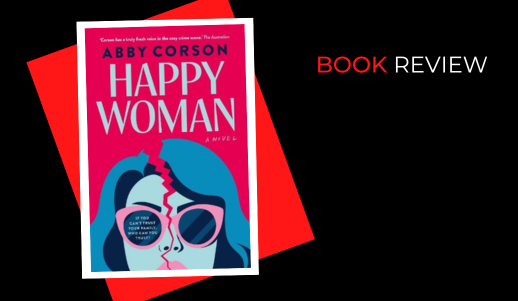
Author: Abby Corson
Publisher: Hardie Grant
Reviewer: Narrelle Harris
Happy Woman starts with a bang, right out of the gate – in the prologue, Gwynne Hogg is about to step out into the media melee’s accusations of murder in front of a courthouse, but they can’t question her nearly as aggressively as she questions herself: about the choices she’s made and the woman she has become.
Flash back 10 months to the start of the trauma that has led to this moment, when Gwynne’s beloved father Huey is arrested for a series of cold-case murders. The crux of Happy Woman turns out how this great secret unfolds and the impact it has on the Hogg family, and on the community around them.
The novel, written in the second person, is framed as a letter Gwynne is writing to her three year old daughter, Evelyn, revealing every event and the unravelling of her happy life. Second person is an unusual viewpoint to use, but works very well here as a way of revealing the Hogg family history and relationships to the as-yet unsuspecting Evelyn.
Carson explores the impact of violence not only from the perspective of perpetrator and victim, but more especially on how that violence affects people not involved in the crime: the guilt and trauma visited on the killer’s own family, and the angry reaction of the community around them. Gwynne becomes obsessed with whether her father’s murderous violence could be genetic – whether she harbours the same propensity to kill – but those around her must be wondering the same thing, as she, her distracted and distressed mother, and even her little daughter, are shunned and blamed and treated with aggression. Gwynne tries to hold the family together, as well as her father’s business and her own, as well as protecting her daughter, while her husband feels alienated and excluded from the tight-knit Hogg family. She begins to spiral.
In between chapters where Gwynne writes to her daughter for the future, we have transcripts of Huey’s confessions to his lawyer, talking through what happened at each murder, and why. Huey seems so reasonable, and is unusual in how he’s worked hard to protect his own family from this streak of vicious temper.
We may know that Huey Hogg is a killer from the outset, but that doesn’t lessen the impact of the stories and secrets unfolding in the case and in Gwynne Hogg’s life. The mother/father dynamic remains strong, despite the awful things he’s done; the Hogg family become closer as they become targets for hatred and spite and other relationships falter.
And the question remains – is Huey Hogg’s propensity for violence a trait that is shared by his children?
Happy Woman is a keen study of love, fear, trust and the social and personal costs of inherited violence – which may or may not be genetic and yet to some degree seems to be catching.
Publisher Blurb
Perhaps all this time I was merely an origami of a happy woman. Complicated to put together, easy to rip to shreds.
Gwynne Hogg is an enviable woman – until she discovers her beloved dad is a serial killer.
As her dad’s decades-old secrets finally catch up with him, Gwynne struggles to reconcile the man she trusted most with the crimes he’s accused of. She tries to process it all while keeping the wheels of her ‘normal’ life turning. That means caring for her depressed mum, enduring the stares of other parents on the nursery run, and showing up for clients at her PR firm, all under the relentless gaze of the media.
But as the court case unfolds, Gwynne can’t shake the fear that a murderous gene might live inside her too.
Her thoughts grow darker, her once-happy life unravels, and she begins to wonder what she herself might be capable of …