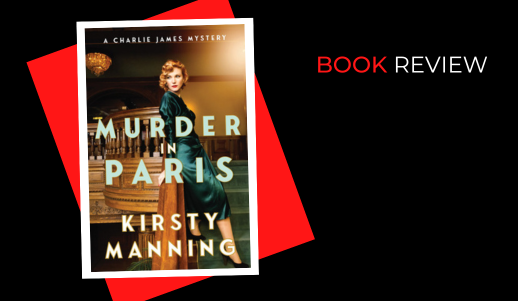
Author: Kirsty Manning
Publisher: Allen & Unwin
Reviewer: Rachel Nightingale
A Charlie James mystery.
From its very first sentence, Murder in Paris draws us into a glamorous world of socialites, couture dress and champagne for breakfast. The protagonist, Charlie (Charlotte) James, is a journalist from Sydney living the high life in Paris after leaving a broken marriage. Although working for the Paris office of The Times, Charlie has society connections through her friend Violet. When she is tasked by Lady Ashworth with looking into the disappearance of American socialite Maisy Bell, these connections, along with her journalistic curiosity and endless determination, drive Charlie to pursue the truth, even when the police have decided there is no mystery to uncover. Along the way she is caught up in investigating a series of possibly unrelated murders, unexpected romance, and a side job as a model.
Charlie is an inquisitive, tenacious heroine, while her best friend Violet is a driven career woman, holding down a job while running a fashion house. Between them they have the pluck and passion to keep searching for Maisy, despite the many obstacles that arise. Charlie has something to prove after an experience that has seen her confined to light puff pieces for the paper, and is also frustrated that no one seems concerned with Maisy’s disappearance, even as time ticks away. Having two such women at the heart of the story makes for an engaging narrative.
With its lush descriptive language, Murder in Paris evokes the Paris of 1938, a place of beauty and glamour, with scenes set in the Palais Garnier Theatre, the Ritz, the Luxembourg Gardens and various parks, shops and cafes. The novel truly captures the atmosphere of cultural delights and vivid life, transporting the reader to a Paris depicted with loving familiarity and immersing them in the pleasures of summer, of light and colour, delicious foods, and the pleasures of Parisian markets. There are only occasional hints of what is to come in the next few years, when war will change things forever.
The bright Parisian summer lures the reader in, suggesting the police are correct that Maisy’s disappearance is unlikely to be due to something as dark as a kidnapping. But as time passes and the story progresses, Charlie uncovers the dark underbelly of the city she has made her home. This contrast works well to create growing tension, establishing a double world, where glamour and culture create a brightness that casts shadows in which crime can hide. It is only Charlie’s refusal to let Maisy be forgotten that stops the missing young woman’s story from being swept into the past as the world moves on with its pleasures. This makes the point well that too often in crime we move on from the victims, caught up in our own bright lives.
If you enjoy historical fiction in the vein of Phryne Fisher, with a plucky heroine, plenty of glamour, and dark shadows creeping in, then Murder in Paris ticks all the boxes.
Publisher blurb
A glamorous historical mystery of murder, fashion, food, secrets, and danger in 1930s Paris.
The inimitable Charlotte ‘Charlie’ James returns in her second exciting mystery.
At a glitzy gala in the ballroom of the Hotel Ritz, young American tourist Maisy Bell meets an intriguing man and accepts his charming offer to take her on a day trip.
But when Maisy doesn’t return to the Ritz the following day, alarm bells ring and Maisy’s aunt Clementine tries to file a missing person’s report. The Paris police laugh the request away. Plenty of tourists ‘disappear’, having lost themselves in foolish flings. After all, summer in Paris is the perfect time for lovers. Then Clementine Bell receives a ransom note …
Enter investigative reporter Charlie James. As she follows Maisy Bell’s designer footsteps around Paris, Charlie is plunged into a heady world of diamonds, haute couture, opera, bohemian wine bars and extravagant soirees in grand country châteaux, before being pulled into the sordid underworld.
Glamorous and fearless, glass of champagne in hand, this is Charlie James at her best.