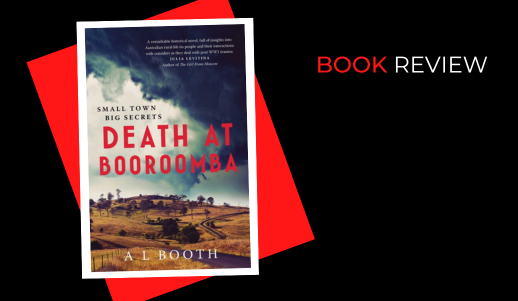
By A. L. Booth
Publisher: Ventura Press (Simon and Schuster)
Reviewed by Rachel Rossignol
Death at Booroomba is a historical murder mystery set in rural Australia, but also a war story. It opens with young Jack O’Rourke rescuing an old man, Samuel Lomond, who has fallen into Sydney Harbour. This split second decision will change the trajectory of Jack’s life, leading him to opportunity and danger four years later when he unexpectedly inherits Lomond’s rural property, Booroomba. It appears Lomond’s death was murder, so Jack soon finds himself facing a web of suspicion. It’s hard enough being the new person in a small town, but when the townsfolk think your inheritance is a motive for murder, and you are wondering which of them is the actual killer, making friends and fitting in is the least of your worries.
For Jack, the unease he feels is worsened by memories of his recent experiences in the Great War. Otherwise benign moments become traumatic when PTSD flashbacks overtake him. Then a robbery and fire at Booroomba shift his unease into real fear. This sets up the core tension of the novel – who killed Lomond, and do they have reason to come after Jack? Faced with hostility from resentful townsfolk, with only a few who are extending the hand of friendship, Jack is torn between selling up, and wanting to achieve justice for his murdered friend.
Despite his war experiences, Jack’s main qualifications for solving the murder are a willingness to ask lots of questions, and persistence. He’s up against an obstructive policeman, a slick landowner hounding him over selling Booroomba, and a feisty female newspaper owner. As he investigates Lomond’s murder he ruffles feathers by uncovering secrets that many want to remain covered.
Booth artfully uses several writing devices to take us inside Jack’s internal world, so that all of this plays out as though you are walking alongside him. The story is written in the past tense, but PTSD flashbacks are written in present tense, in a clever reversal that gives them terrifying, evocative immediacy. Although third person is used throughout, there are many moments where readers become aware they are seeing Booroomba and the town through Jack’s worldview, with its deep appreciation for the simple sight of nature and the simple pleasure of a cup of tea after the terror of war. This is heightened by the colloquial tone of the text, which gives you a real sense of Jack as a character.
Booth has a sharp ear for different voices, creating distinct, believable characters. With a few well chosen words, she gives them depth, peopling the story with a range of interesting personalities. Descriptions of the land are more detailed, creating images of clarity and beauty. There is exploration of key issues of the time, including immigration, war and the Spanish flu. But what drives Death at Booroomba is Jack’s likeability, making the reader hope that things will work out for him and that his unexpected inheritance will not turn out to be a curse.
Publisher’s blurb
In 1915, two days before being sent to fight in WWI, Jack O’Rourke dived into Sydney Harbour to save a drowning stranger, Samuel Lomond. Four years later, battle-scarred and weary, Jack returns home only to discover that Samuel has been brutally murdered – and that he’s been left his rural property, Booroomba.
When Jack arrives in Warrawolong, a small town near Eden, to claim his inheritance, he finds only hostile stares. Suspected of the crime by the townsfolk and local constable, Jack launches his own investigation into Samuel’s death – and soon discovers the townsfolk aren’t as innocent as they seem.
Now Jack must expose a killer hiding in plain sight – before he becomes the next victim of a decades-old conspiracy.
A neighbour coveting water rights, a struggling newspaper proprietor, a vengeful labourer, a secret affair and two Russian émigrés lead Jack right to the heart of the crime. A small town hides big secrets, in A L Booth’s deeply evocative historical whodunnit.