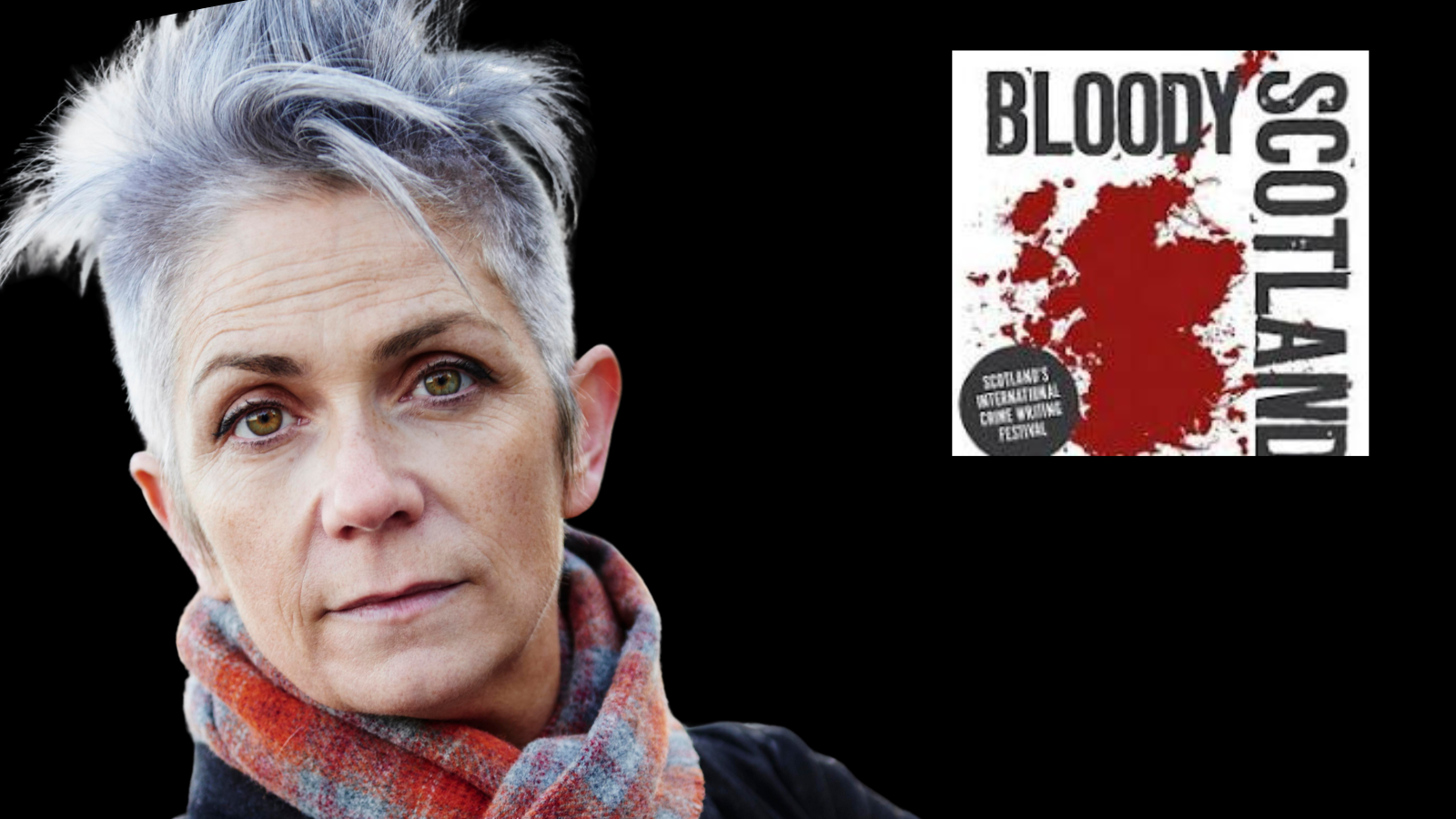
Sisters in Crime’s roving reporter Lucy Sussex is attending the crime festival Bloody Scotland in September. As a taster, a wee dram, she interviewed Tartan noir author Denise Mina. Since 1996, Mina has produced twenty award-winning crime novels, also plays, comics, and graphic novels. In 2014, she was inducted into the Crime Writers’ Hall of Fame. Her latest, The Good Liar, is a thriller about conscience and consequences: what happens when a forensic expert comes to distrust her own science. It is longlisted for the 2025 McIlvanney Prize, awarded at Bloody Scotland.
Lucy: You are a Dame. For services to literature?
Denise: Actually, services to fraud, Lucy. I started claiming a Damehood when I was about twenty. Because I thought it was funny. And now I’m at the stage where people think I have got a damehood. I think the honours system is absolute bullshit, and I’m trying to undermine it.
Lucy: Sue Turnbull asks how you found your voice.
Denise: The oral tradition. I see crime fiction as telling a story rather than writing a story, as if I was imagining myself telling a story to a female friend. You wouldn’t be grandiose, nor claim to know everything. You would be self-deprecating, funny, absurd, but also quite frightening. You know the way women tell each other about a creepy guy at a bus stop? That sort of storytelling. The best storytellers I know are women.
Lucy: Your narratives move like trains. How do you do that?
Denise: It partly started with coming from a very big family of good storytellers. You find out very quickly what works and doesn’t work. I am also very strict with myself, actually working out the structure, where pace and tension come from. Structure is so important.
Lucy: In The Long Drop [based on a true case], you distinguish between good and bad narratives, as when the murderer is lying, unbelievably.
Denise: There’s something about being told a bad lie that is incredibly insulting, like Erin Patterson [the Mushroom Murderer]. There’s the offence of killing all those lovely people, but also the offence of not telling a good lie to cover it up.
Lucy: Is it easier to write from an existing true crime?
Denise: In some ways, true life is absurd and less believable than fiction. It’s much easier to write because you don’t have to think that nobody would be that funny, or that clever. If you’re told to write a short story, that’s really difficult. But if someone says write a short story of 450 words, with a dog and a pint of whisky in it, that’s much easier because the limitations are what make the work. I think fiction’s much harder.
Lucy: How did you come to write Rizzio, about Mary Queen of Scots?
Denise: [Publisher] James Crawford suggested it. I come from a very belligerent Irish Catholic family, not interested in anything royal; we’re all Republicans. But I thought, yeah, I’ll just do it. And I got so into it. Such an interesting time in Scottish history, such a misogynistic culture. We’re still feeling the echoes of that. And I’ve actually adapted it as a play, hopefully for the Edinburgh Festival next year.
Lucy: Why in The Good Liar did you move from Scotland to London and the alien world of the upper class?
Denise: It had to be London because forensic services have been privatized in England and Wales since 2012. And also, there is a concentration of power in London.
Lucy: Sue Turnbull also asks about the social justice in your work.
Denise: Are you just trying to draw attention to yourself and make money? There has to be a higher purpose, surely. If you observe injustice socially, you should try to use your writing to do something. Narrative is a great way to draw people’s eyes to injustice. And I do think that crime fiction is the new social novel.
Bloody Scotland runs in Stirling, 12-14 September 2025. Online coverage, including the prize-giving, is available at bloodyscotland.com/digital-pass £6 for an individual event and £60 for the full pass.
More info about Denise Mina here.