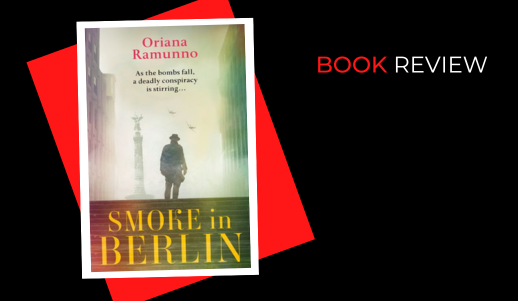
by Oriana Ramunno. Translated from the Italian by Antony Shugaa
Publisher: Harper Collins Australia
Reviewer: Rachel Nightingale
Book #2 Hugo Fischer
Warnings: review contains spoilers for the first book, and the subject matter is dark, covering Auschwitz, war, as well as Nazis and their pursuit of Jewish and Roma peoples.
Smoke in Berlin is the second book in a series about criminologist Hugo Fischer. In the first book, Ashes in the Snow, Fischer uncovered the truth of what was happening at Auschwitz while investigating the death of an SS officer, and secretly removed a Jewish child, Gioele, from the concentration camp. In this second book, Fischer is still haunted by the truths he learned during that investigation, and what that knowledge made him confront within his own conscience. He has left the Nazi party as a result. Yet he hasn’t been able to completely escape their grasp.
When he is called upon to investigate the shooting murder of a prominent Nazi couple, Fischer must walk a very precarious tightrope. Officials have already deemed the deaths a murder/suicide, and he is expected to rubber stamp that ruling, but his instincts are telling him otherwise. Contradicting the party’s official position is beyond unwise and Fischer has more to lose than most. He is now passing off Gioele as his own son, hiding the child’s Jewish identity. He is also living with MS, a condition which, if discovered, is likely to rob him of his work. Fischer’s investigation thus begins with high stakes, and these only continue to rise.
Unsurprisingly, given the setting, this is a dark and blood soaked telling. Both Gioele and Fischer are haunted by memories of Auschwitz. Other characters are also haunted by a past or present of fear and destruction, or are facing imminent danger. There are frequent shifts of time and perspective that deliberately disturb and disorient the reader, evoking a time and place (Berlin, 1944) where a city and its inhabitants are worn down to ruins by the persistent danger and destruction of war and Nazi rule. Evocative descriptions of a city reduced to rubble by bombing form the backdrop to a mystery that soon sees the deaths piling up. As a historical piece the novel works well, using the right amount of detail to transport the reader, while a sub-plot about the persecution of the Roma people brings to light a lesser examined aspect of Nazi atrocities.
A common convention in crime fiction is that those who may hold answers to what has happened hide their knowledge. In Smoke in Berlin this convention is taken to its extreme because trust and truth could literally cost lives. The risks underpinning the investigation are high. Characters are complex, their differing ideologies and motivations reflective of their experiences and the dangerous environment in which they live.
Despite the darkness throughout, Smoke in Berlin has an underlying theme of hope amidst destruction. The small but greatly heroic acts throughout are based on the acts of real people and reflect events that occurred during the height of Nazi power. In the face of enormous obstacles and risks, the story reaches a satisfying conclusion. Smoke in Berlin is a celebration of the unquenchable flame of hope and humanity that persists even in the face of evil acts and dark times.
Publishers blurb
A beautiful, atmospheric detective story set in Berlin during The Second World War.
Oriana Ramunno’s Hugo Fischer series is full of tension, drama and, ultimately, hope.
A detective with a secret
Berlin, June 1944. Hugo Fischer is forced to work for the Nazi secret service, but he carries dangerous secrets he must conceal. Gioele is not his son, but a Jewish boy he rescued during an investigation at Auschwitz.
A fateful series of crimes
The murder of a prominent Nazi couple. The suicide of a Reich journalist. An alleged accident that killed fifteen Hitler Youth children.
As Fischer investigates, he begins to suspect the deaths in Berlin are intertwined.
A city fighting back
But when suspicion starts to fall Fischer’s way, he finds himself walking a knife edge. To be found part of the conspiracy means death. Yet how can he betray those who stand up for what is right?