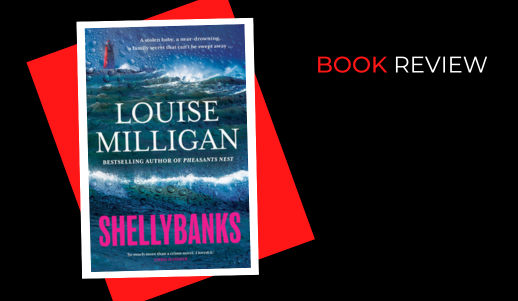
Author: Louise Milligan
Publisher: Allen & Unwin
Reviewer: Carol Woeltjes
My vision was beginning to blur with unshed tears before I’d read 20 pages of Shellybanks. I felt as if I was watching someone right in front of me grapple with trauma. They are trying to be normal and functional, to do what’s expected, but on the inside they’re in pieces.
Functional yet broken could be used to describe many of the characters within Shellybanks pages. There’s Sinéad, a young woman who knows she’s not being told the truth, Dolores, a ‘bold’ woman living with the ramifications of a childhood marked by conservation ideologies and too many mouths to feed, Liam, a man struggling with helplessness and fear while desperately trying to not let it show, and then there’s Kate.
Functional may be pushing it a bit when describing Kate. I first met Kate in Pheasants Nest, Louise Milligan’s first novel, and to say that Kate is still dealing with her ordeal is an understatement. Kate openly tells you the gist of what she’s experienced, so if you haven’t read Pheasants Nest you won’t be left behind.
This novel packs a punch, but I guess it shouldn’t be a surprise given the calibre of Milligan’s journalistic work. It has echoes of the real stories Milligan is well known for, with the abuse of power by religious entities a central theme. At times I felt an intense claustrophobia, and a little intrusive as the portrayal was so vivid and raw.
Speaking of raw, I found the removal interesting and a little confronting. Now I’m a nurse, I’ve been around a few dead bodies, but the idea of sitting around a stuffy funeral home with an open casket chatting and saying our last goodbyes is just a little off-putting. This got me wondering about how we deal with loss and grief and thinking that maybe the Irish way is better, you confront it head on, no denial possible.
But enough of loss and heartbreak. In Shellybanks, Milligan has crafted some of the most endearing characters I’ve met in a while, particularly Dolores, I ‘fecking’ love her. There is also the language, it’s such a joy to read phrases that tell you so much with so little, I could quote dozens, but I’m going to leave you to find the gems that speak to you.
Now, I struggle a little to describe Shellybanks as the second in a series, there is a commonality with Pheasants Nest, but the story is not Kate’s. She is, however, the link that allows the greater story of Shellybanks to be told.
I don’t know how to describe how real this story felt to me, and as a result how important I have come to view it. I think the telling of stories such as this in a novelistic form have the power to reach a broader audience because it’s entertaining, but more importantly it may show someone who needs it they are not alone.
Publisher blurb
On the sands of Shellybanks, where tides can quickly turn treacherous, journalist Kate Delaney once nearly drowned. Years later, reeling from a violent crime that has upended her life in Melbourne, she returns to Dublin to comfort her beloved aunt Dolores—only to discover Dolores has her own buried trauma.
As a teenager, Dolores was drawn into a disturbing religious movement that stole her youth, her freedom, and so much more. With Kate’s help, she is determined to confront the powerful network that made her suffer years of silence and shame.
Shellybanks is a haunting tale of secrecy and survival, charting how two women find strength in each other as they reckon with Ireland’s hidden histories and the scars that endure across generations.