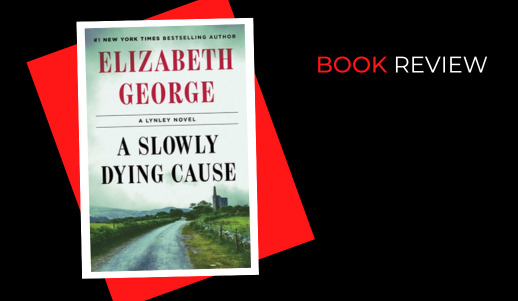
by Elizabeth George
Publisher: Pan Macmillan Australia
Reviewed by Jacquie Byron
I’ve always had a soft spot for Elizabeth George and her Inspector Lynley series, even though it had been years since I last read one. A Slowly Dying Cause reminded me just how meticulous a researcher and writer George is. I had almost forgotten how intricate she can be, not just in plotting but in emotional layering, shifting perspectives and sheer narrative ambition.
This is not quite the book you might expect. Told from multiple points of view, the chapters featuring Michael Lobb add particular depth and nuance to the story. This book is also noticeably “sexier” than I remember the Lynley series generally being. You have been warned.
George’s penchant for doorstop-size books continues with this one. I’d roll my eyes at anyone claiming they read this one in a single sitting. This length, however, allows the reader to truly know the characters and their lives. Even side characters feel fully dimensional rather than merely functional. There were moments when the pacing dragged for me, but my curiosity about what was really going on kept me reading.
That persistence pays off. There is a genuinely effective “big twist” in the final fifty or so pages that delivers a satisfying a-ha moment and clarifies some of the narrative choices George makes throughout. It reminded me why I so enjoyed her excellent non-fiction book Write Away: One Novelist’s Approach to Fiction and the Writing Life, which I’d highly recommend to any aspiring writers.
As always, the personal and emotional lives of the detectives are given generous space. Lynley’s enduring grief over the death of his wife and child continues to shape him, but this novel places particular emphasis on his family and ancestral home, Howenstow. His mother and sister feature prominently, and the gradual physical decline of the house and grounds becomes thematically relevant to the story itself. There is a great deal of reverence for Lynley’s status as the eighth Earl of Asherton and the world he comes from. At times I wondered whether George’s detailed attention to ivory-inlaid tables and aristocratic ritual reflects the persistent American fascination with British pomp and circumstance we sometimes see in politics and culture. Hello President Trump being hosted at Windsor or Meghan and Harry with Oprah!
Seeing Howenstow through both Lynley’s and Havers’ eyes is a good touch. Havers is often outwardly dismissive of her DI’s lineage yet equally intimidated by it. Finding herself as a house guest within “the family pile” offers up some amusing moments. By the twenty-second instalment, there’s an undeniable sense of comfort in these characters. For me, reconnecting with Tommy and Barbara felt a bit like catching up with old friends.
Havers’ storyline is emotionally weighty in a specific way. The dementia and death of her mother – no spoiler, as it occurs early on – permeates the novel. Havers’ poor coping mechanisms in her personal life are a hallmark of the series. This time around she is struggling with guilt, grief and the unresolved complexity of her relationship with her mother. At the same time this storyline allows George to delicately honour those who provide essential care to people with dementia via a character called Mrs Flo.
There’s also a small but amusing Easter egg: a bit of snide commentary aimed at Harry Potter. Havers dusts off her long-abandoned copy in the hope it might at least cure her insomnia. Maybe Elizabeth George is not a fan girl of the wizard or his creator.
At its core, A Slowly Dying Cause is grounded in its Cornish setting. Tin mining, modern lithium extraction, local culture and environmental concerns all feature heavily, showcasing George’s exhaustive research. I’ll admit this element was not always hugely engrossing for me but that probably reflects my failings rather than the author’s. What was more compelling was the sustained examination of family: the very best and the very worst of it. George roams widely, from horrific abuse and neglect to everyday missteps, and on to the quiet, beautiful acts of ordinary familial love.
Beatrice Hannaford is the other key character in terms of the crime solving team. Predictably, George gives the Detective Inspector her full attention, exploring the complexities of the DI’s marriage and her delicate relationship with her son. The situation Hannaford finds herself in – primarily with an on-again, off-again husband – feels real. Particularly striking is the way Hannaford acknowledges her professional mistakes. George presents them in a sympathetic light, a rare occurrence in crime fiction which gives this story a fresh edge.
Overall, A Slowly Dying Cause is dense, demanding and occasionally unwieldy, but also rich, thoughtful, and emotionally resonant. It reminded me exactly why Elizabeth George has sold so many books, won so many awards, and why the Lynley television series continues to find new life in a current reboot.
Publishers blurb
In Cornwall, a man suffers a violent death – and the killer may lurk within the community . . .
Featuring Detectives Barbara Havers and Thomas Lynley, A Slowly Dying Cause is an atmospheric, gripping crime thriller from bestselling author Elizabeth George.
Amid the beauty of Cornwall’s coastline, the death of a local man shatters the peace with its violence. The body of Michael Lobb was discovered in his family’s tin and pewter workshop, and Detective Inspector Beatrice Hannaford is brought in to investigate. Suspicion quickly develops when it emerges that a mining company had been trying to buy the man’s land, and Lobb was the only remaining obstacle to the deal going through.
But every step of Bea’s investigation provokes more questions than answers, and the complexity of the case develops further as Lobb’s family life, rife with mistrust and deception, comes to light. With cryptic alibis and shifting motives, the tangled web of intrigue soon draws in her colleagues Thomas Lynley and Barbara Havers, who must search for a killer in a community that has very little trust in outsiders . .