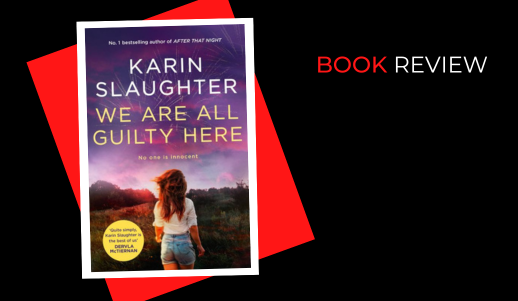
by Karin Slaughter
Publisher: Harper Collins Australia, 2025
Review by Jacquie Byron
I suspect there’s a very particular feeling a crime fiction fan gets when they open the first page of a book by someone like Karin Slaughter. It’s called confidence. You know what you’re going to get in terms of quality, sure-handedness, story and plotting. After all, she has 24 novels and 40 million sales to her name. A book by her is always solid, sharp, and gripping – as demonstrated in We Are All Guilty Here.
Of course, you’re also going to get some downright brutal and unflinching violence. This is a writer who doesn’t shy away from smashing bones or drowning a character just because that character is a child. You have been warned.
We Are All Guilty Here spans a time jump – two crimes, twelve years apart – each as heinous as the other. Violence against women and girls is a theme Slaughter confronts head-on, never flinching. It’s an intriguing contrast, given that in interviews and on social media she comes across as warm, approachable, modest and witty. Thankfully, she reserves her blackest thoughts for her fiction.
This is the first book to star Emmy Clifton in what is planned as a new crime thriller series. I confess I’m not usually a series reader; indeed, Slaughter’s 2015 standalone Pretty Girls remains one of my favourites of hers. Still, when Jude Archer, an enigmatic, recently retired FBI profiler, steps onto the page, and I reached the paragraph where it became clear they were going to team up, I couldn’t help but feel a flicker of anticipation.
There’s lots of backstory and world-building in We Are All Guilty Here, plus snippets of information about Emmy and the broader Clifton family which will undoubtedly grow in importance as the series unfolds. Slaughter is sowing seeds to be harnessed for myriad story threads down the track. In this first book, however, Emmy’s life – raising her young son while taking care of aging parents – will ring true to many readers.
The world of an elected sheriff might be unfamiliar to Australian readers, as might the concept of one wealthy family essentially owning a town over generations – though we likely have our own versions. Slaughter, who grew up in a small town in Georgia, has spoken about how, as a child, she longed to escape, much like 15-year-old Madison, who plays a pivotal role in this story. Slaughter convincingly inhabits and expresses that teenage mindset. In interviews, she has also acknowledged that the Murdaugh family saga (a real-life collapse of a powerful Southern dynasty steeped in privilege, corruption and, ultimately, murder) influenced her thinking on how one family can dominate a town for generations and how deeply corrupt that kind of power can become. This story is not that story, but there are echoes.
Some of the classic strengths that define Slaughter’s work also underpin this book. She renders the technical intricacies of a rifle’s 16-inch hammer-forged barrel and 30-round magazine with as much precision as she does the ugly terrain between close girlfriends, whose intimate understanding allows them to wound one another like no one else.
A hallmark of Slaughter’s emotional depth and insight is the scene where the mother of a murdered teen expresses regret that her daughter will forever be caught between the child she was and the woman she’ll never become – stuck in that twilight zone of rebellious adolescence with the transformation into a self-possessed adult tragically cut short. Anyone with a child or a heart can imagine how distressing that loss must be. Such raw, sometimes subtle observations consistently elevate Slaughter’s books.
Equally notable is her meticulous attention to detail, which brings her stories to life. The detailed, almost voyeuristic realism in the procedural elements further distinguishes her style. For example, the small-town jail where Emmy works vividly comes to life as the deputy sheriff methodically “badges” her way through various areas, noting cameras and cells while moving between the blocks. This blend of emotional insight and precise, immersive detail is always impressive.
While the plot is complex, Slaughter doesn’t cheat the reader. Tiny, seemingly inconsequential details are dropped throughout, and when finally recognised by Emmy and Jude, these clues coalesce to reveal the perpetrator and the circumstances of the crimes. It’s convoluted, but if you’re a nerd like me and go back to check, you’ll uncover a fiendishly clever join-the-dots puzzle in a book that I found both unsettling and engrossing. If you’re looking for a series to get hooked on and can handle gritty details, this could be for you. Also, in today’s America and the era of Trump, I found this eloquent and broadminded native author offers compelling insight into the complexities of the South.
Publisher’s blurb
Welcome to North Falls.
A small town where everyone knows everyone. But nobody knows the truth.
Emmy Clifton has lived here all her life. She thinks she knows her neighbours. She’s wrong.
She thinks it’s just another hot summer night: a night like any other. She’s wrong.
When her best friend’s daughter asks for help, she thinks it’s just some teenage drama. She thinks it can wait. She’s never been more wrong in her life.
As the town ignites in the wake of the girl’s disappearance, Emmy throws herself into the search. But then she realises: You never really know a town until you know its secrets.
Is Emmy ready for the truth?